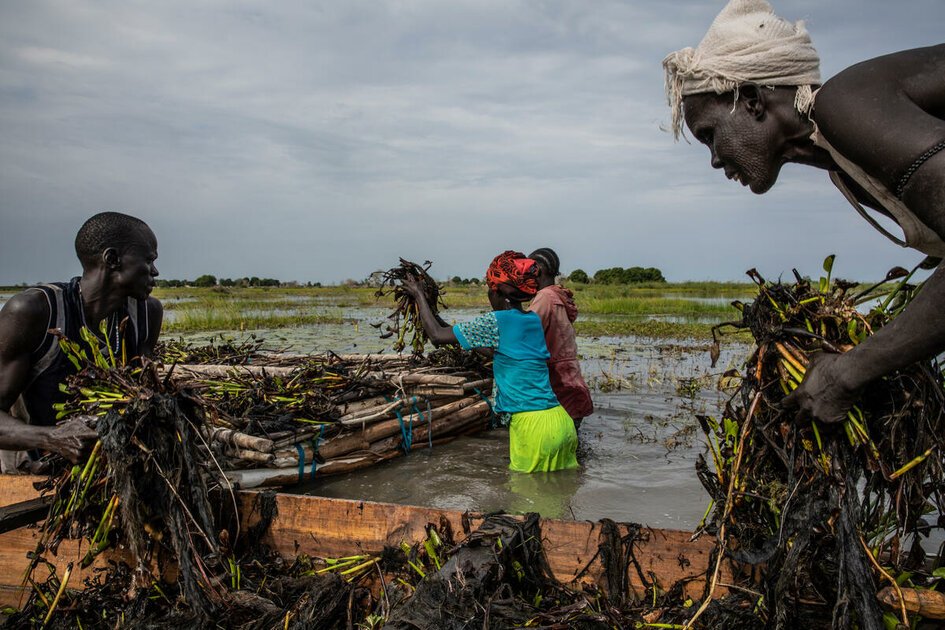
Across the remote Akuak islands, families rely almost entirely on fishing to survive, spending long hours each day strengthening and repairing the fragile land beneath their homes.
Their small huts sit beside one of the many winding channels carved by the Nile inside this vast swamp. In every direction, there is only water, tall grass and papyrus, a place the Dinka people call toich.
The Norwegian Foreign Policy Institute describes South Sudan as one of the world’s most flood-prone countries, warning that communities are highly exposed to seasonal river flooding that has grown more intense over time. Researchers note that floods once retreated during the dry season between November and January, but repeated years of extreme flooding have now permanently altered the land.
Some climate specialists link this change to warmer sea temperatures that trigger heavier rainfall across East Africa. They believe this could lead to the long-term expansion of the Sudd, Africa’s largest wetland which stretches along the Nile floodplain north of Bor in South Sudan.
While many communities in Jonglei state were forced to flee with their cattle during the severe floods of 2020, the Akuak remained. Long before then, they had already begun to adapt.
Like other Dinka groups, the Akuak once depended on cattle. But rising water levels in the late 1980s pushed them to abandon livestock and turn fully to fishing. According to their chief, Makech Kuol Kuany, they chose to stay on their land rather than follow their cattle.
“When the water rises, we use grass and soil to build these islands,” explains Anyeth Manyang. “I learned this from my parents. This is how we survive.”
South Sudan ranks as the seventh most climate-vulnerable country in the world. This year alone, flooding displaced more than 375,000 people, according to the UN’s disaster coordination agency, UNOCHA. There is still no clear sign of when the water might retreat.
Ayen Deng Duot, a mother of six, is among those working constantly to enlarge the soft mix of plants and clay that supports her home. For her family, each year brings the same struggle.“We live on low land,” she says. “When the Nile or the rains flood, we must protect ourselves so the water doesn’t force us away.”
She doubts her family would survive in the city. Others still hope the water will fall, allowing crops to be grown again.Chief Kuany believes it is possible. He recalls the historic floods of the 1960s that lasted nearly ten years before easing. Still, the past few seasons have been relentless, with around 2,000 Akuak people continuing to endure life on these islands.
Fishing remains the heart of their survival, feeding families and sustaining what little livestock remains.